Reverse Mortgage Eligibility: Check Requirements and Criteria Here

Blog

Reverse Mortgage Eligibility: Check Requirements and Criteria Here

Confused by reverse mortgage rules? Check the latest reverse mortgage eligibility requirements here. Discover age limits, property rules.
March 10, 2026
·
5 min read

Written by

Eric
Author from Zeitro

Share this article

Subscribe to updates

Thank you! Your submission has been received!
Oops! Something went wrong while submitting the form.

Let's talk about tapping into your home's value during retirement. A reverse mortgage sounds like an easy fix for cash flow, but the eligibility rules trip up a lot of people. You can't just sign a paper and get a check. Lenders have strict criteria you have to meet first, and the paperwork gets complicated fast.

Instead of getting lost in confusing guidelines, both homeowners and loan officers can actually check reverse mortgage eligibility requirements for free using smart platforms like Zeitro. Let's walk through exactly what it takes to qualify, what might get you rejected, and how to verify everything without the usual stress.

What is a Reverse Mortgage?

Generally speaking, a reverse mortgage is a loan specifically designed for older homeowners. Rather than you paying the bank every month, the lender pays you by converting a chunk of your home equity into cash. The loan balance doesn't come due until you sell the property, move out permanently, or pass away.

There isn't just one standard product out there. You generally have three types to look at:

  • Home Equity Conversion Mortgages (HECMs): These are federally insured by the FHA. They are the most common and have the strictest guidelines.
  • Proprietary reverse mortgages: Think of these as private loans. They are usually meant for high-value properties that exceed normal FHA limits.
  • Single-purpose reverse mortgages: Offered by some state or local agencies. They cost less but restrict exactly how you use the money, like strictly for property taxes.

What are Reverse Mortgage Eligibility Requirements?

Assuming you qualify just because your mortgage is paid off is a huge mistake. The Federal Housing Administration sets a rigid baseline for HECMs, mostly to ensure borrowers don't end up in a worse financial spot down the road. I've seen applications stall out simply because people missed one minor detail.

Here is what you actually need to check off the list:

  • Age limit: The youngest person on the title must be at least 62. No workarounds here.
  • Property type restrictions: This loan only works for your primary residence. Forget about using a vacation home or an investment property you rent out.
  • Sufficient equity: You either need to own the house free and clear or have paid down a massive chunk of your current mortgage, usually hitting around 50% equity.
  • Passing the financial assessment: Underwriters will dig into your credit history and cash flow. You have to prove you can handle ongoing costs like property taxes, HOA fees, and homeowner's insurance.
  • Mandatory counseling session: Before anything gets approved, the government requires you to meet with a HUD-approved counselor. They make sure you truly understand how this loan affects your future and your heirs. Taking this step seriously protects you from predatory lending practices.

What are Reverse Mortgage Eligibility Requirements?

What Disqualifies You from Getting a Reverse Mortgage?

Finding out you don't qualify after weeks of paperwork is frustrating. I always tell clients to look at the dealbreakers first. Lenders will hand out a quick rejection if you hit any of these roadblocks.

You'll likely get denied if:

  • Age: You or a co-borrower hasn't hit that 62nd birthday yet.
  • Equity shortage: Your existing mortgage balance is simply too high.
  • Residency issues: You spend more than half the year living somewhere else.
  • Financial red flags: The lender decides your income won't cover basic property taxes and insurance premiums.
  • Federal debt: You have unresolved delinquent federal debt, like unpaid income taxes or defaulted student loans.
What Disqualifies You from Getting a Reverse Mortgage?

Tip: How to Accurately and Quickly Verify Reverse Mortgage Eligibility?

If you work in the mortgage industry, you already know that manually checking FHA handbooks and investor overlays is a massive time sink. Guidelines change, and trying to memorize credit and property restrictions is virtually impossible. That's why relying on old PDFs is risky.

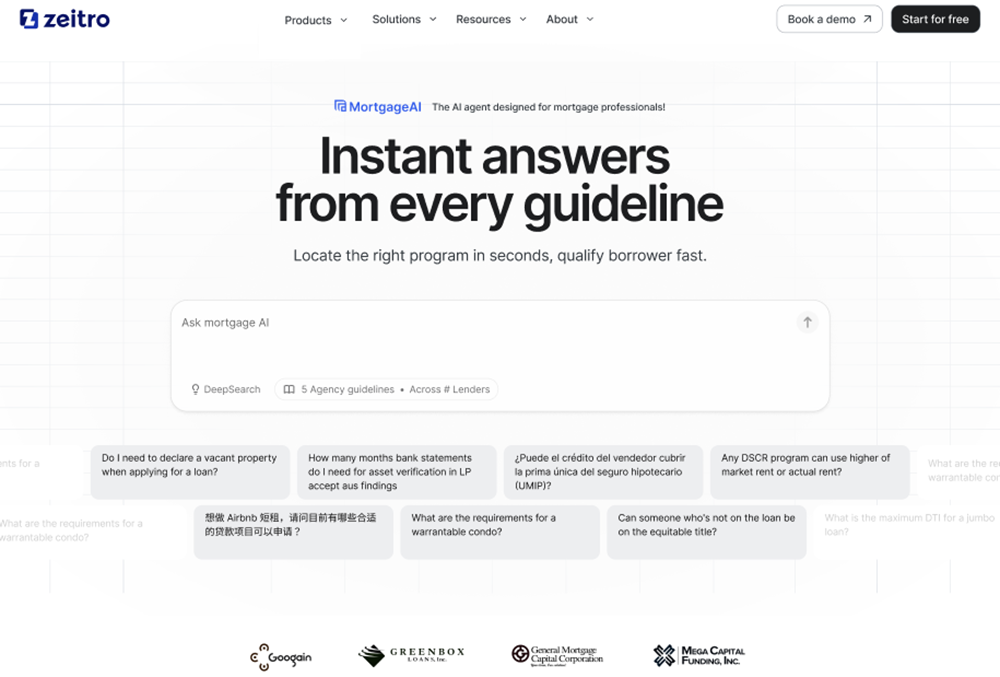
I started pointing professionals toward Zeitro Strata AI. It's an AI-native SaaS tool built purely for the mortgage space, and it essentially kills the need for manual guideline research.
Tip: How to Accurately and Quickly Verify Reverse Mortgage Eligibility?

Here is what makes it stand out:

  • Instant answers across the board: The DeepSearch feature cross-checks over 100 investors and 300+ guidelines (covering conventional, non-QM, DSCR, and more). It turns a 30-minute manual lookup into a two-second query.
  • Real source citations: It doesn't just guess. Every single answer includes a direct citation back to the original guideline, giving you the confidence that the data is 100% accurate.
  • Handles messy questions: Borrowers rarely fit a perfect mold. You can type in vague scenarios or highly specific requirements in English or Chinese, and it still pulls the right rules.
  • Built-in 'Explain' tool: If a specific underwriting rule still looks like gibberish, you can hit the explain function to get a plain-English breakdown of that specific text.
  • Free daily access: You can actually test it out without committing. The platform gives you 3 free queries every day to run your own scenarios.

FAQs About Reverse Mortgage Eligibility

Q1. Is there a credit score or income requirement for a reverse mortgage?

There isn't a hard credit score cutoff. However, lenders run a financial assessment. They just want to ensure your cash flow can handle the ongoing property taxes and home insurance. If your credit is rough, they might require a set-aside account to cover those bills.

Q2. What is the 95% rule on a reverse mortgage?

It's a safety net. Since these are non-recourse loans, you or your heirs will never owe more than the loan balance or 95% of the home's appraised value when it's time to sell and settle the debt, whichever is lower.

Q3. What is the biggest problem with a reverse mortgage?

The upfront costs are painfully high. Between closing costs, origination fees, and compounding interest that grows because you aren't making monthly payments, your home equity gets eaten up much faster than most people expect.

Q4. What is a better alternative to a reverse mortgage?

If you have decent credit and income, a Home Equity Line of Credit (HELOC) or a standard Home Equity Loan usually costs less. Selling the house and downsizing to a cheaper place is often the smartest financial move.

Q5. What is the best age to get a reverse mortgage?

Waiting is usually better. The maximum amount you can borrow is tied directly to your life expectancy. A 75-year-old will qualify to pull out significantly more cash than a 62-year-old.

Q6. Can I lose my home with a reverse mortgage?

Absolutely. You don't have a monthly mortgage bill, but you are still strictly responsible for property taxes, insurance, and basic maintenance. Ignore those, and the lender can foreclose on the house.

Q7. Who owns your house if you have a reverse mortgage?

You do. A lot of people think the bank takes the deed, but that's a myth. You stay on the title. The lender just puts a lien on the property, exactly like they do with a regular mortgage.

Conclusion

Tapping into home equity can save a retirement plan, but the eligibility hurdles are steep. Understanding these rules upfront saves everyone a lot of wasted time.

  • If you're a broker or loan officer tired of fighting through PDF guidelines, check out Zeitro. Their AI tools help pros deliver pre-qualifications 2.5 times faster and bump up loan closes by 30%. It's a massive efficiency boost.
  • On the other hand, if you are a homeowner trying to figure out if you qualify, don't guess. Head to Bluerate. You can find and connect with top loan officers who use these advanced AI tools to give you accurate, free consultations and rate quotes tailored to your exact situation.

People Also Read

Keep reading

USDA Mortgage Explained: Definition, Requirements, Application

Blog

5 min read
Arrow icon on dark background
USDA Mortgage Explained: Definition, Requirements, Application
Looking for a 0% down payment mortgage? Learn USDA loan requirements, income limits, and application steps. Check your eligibility easily with Zeitro Strata AI.

When I first looked into buying a house, I assumed I needed a massive pile of cash. Then I discovered the USDA loan, one of the best zero-down-payment options available for low-to-moderate-income families buying in rural and suburban areas.

But figuring out if you qualify can feel like solving a complex puzzle. From strict income caps to hyper-specific eligible locations, the rules are rigid. Luckily, you don't have to guess. You can use Zeitro Strata AI to instantly and accurately verify your mortgage eligibility. In this guide, I'll walk you through exactly what this program is, how it works, and how to get approved.

What Does USDA Stand for?

USDA stands for the United States Department of Agriculture. You might wonder why an agriculture department handles mortgages. It's simple: their core mission here is to boost economic growth and improve the quality of life in rural and suburban communities. By backing these mortgages, the government encourages people to settle outside of heavily populated, expensive urban centers.

What is a USDA Loan?

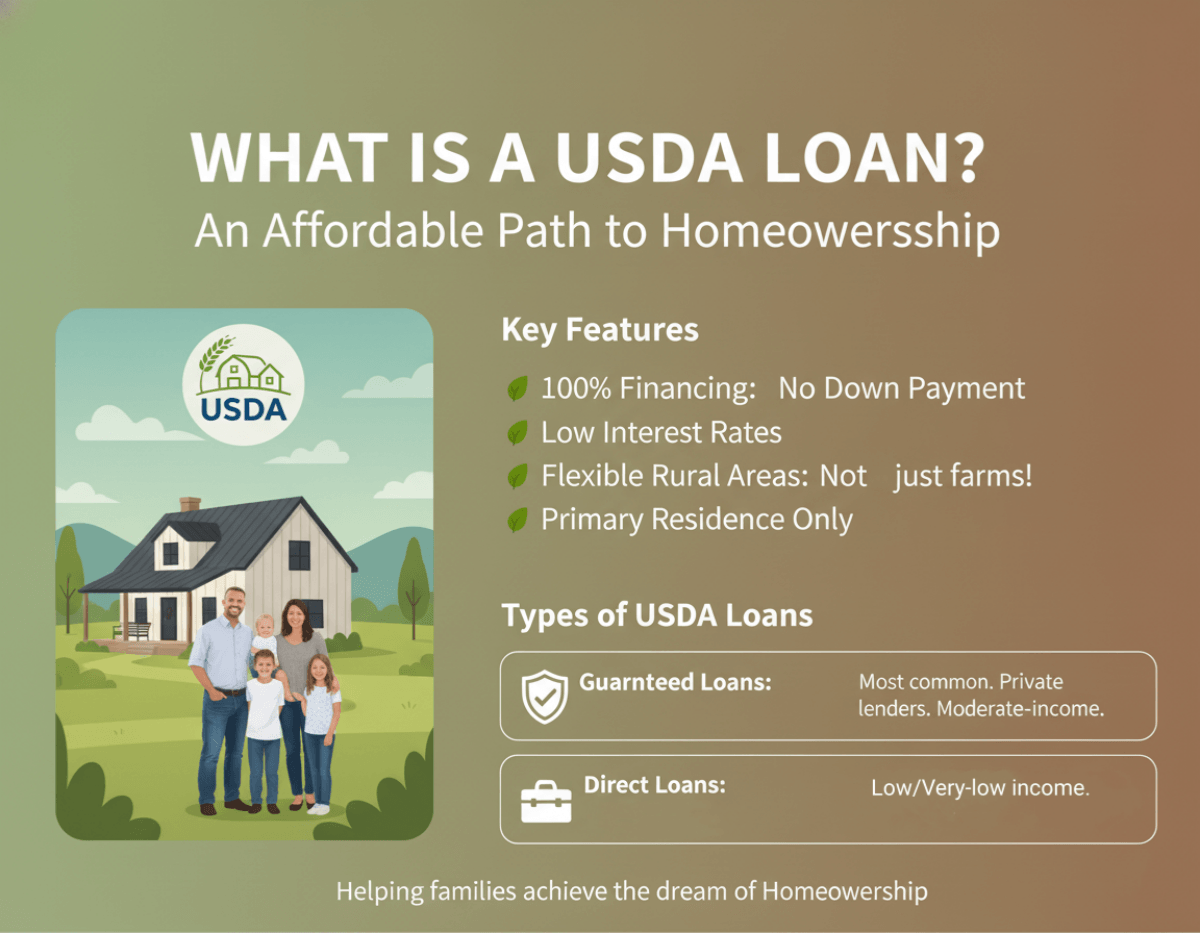
A USDA loan (often referred to as the Section 502 loan program) is a government-backed mortgage designed to help lower- and moderate-income Americans buy homes. Because the government insures a portion of the borrowed amount, private lenders feel completely safe offering 100% financing. That means you can buy a house without putting a single penny down.

When I talk to prospective buyers, their biggest misconception is thinking "rural" means buying a working farm or living miles from civilization. That's simply not true! Many quiet suburbs, small towns, and developments just outside major cities easily qualify. It's an incredible tool for ordinary families who want an affordable path to homeownership without draining their savings accounts.

What is a USDA Loan?

Types of USDA Loans

Not all of these mortgages are exactly the same. Depending on your financial situation, you'll typically look at three distinct options:

  • USDA Guaranteed Loans: This is the most common type. Private lenders issue the funds, and the government guarantees them. It's built for moderate-income buyers who want zero down payment.
  • USDA Direct Loans: Issued directly by the government rather than a bank. This version is strictly for low- and very-low-income applicants who cannot secure traditional financing anywhere else.
  • USDA Home Improvement Loans and Grants: Need a new roof or structural fixes? These funds help homeowners, especially elderly individuals, repair, upgrade, or modernize their existing properties to remove health and safety hazards.

Features of USDA Loans

What makes this mortgage so attractive? Here are the standout features I always highlight to homebuyers:

  • No Down Payment: You get true 100% financing, keeping your savings intact.
  • Competitive Interest Rates: Because of the government backing, lenders can offer slightly lower rates than conventional loans.
  • Upfront Guarantee Fees: 1% of the loan amount, which can be financed into the loan.
  • Annual Guarantee Fee: 0.35% of the remaining principal balance, paid monthly as part of the mortgage payment.
  • Primary Residence Only: You cannot use this program to buy a vacation cabin, a rental duplex, or an investment property. You must live in the house.

How Does a USDA Loan Work?

The way this system works is remarkably straightforward once you look under the hood. For the popular Guaranteed program, the government doesn't actually lend you the cash. Instead, the USDA provides a 90% loan note guarantee to approved lenders, covering up to 90% of the guaranteed portion of the loan in case of default.

Because the bank has this massive safety net, their risk drops dramatically. That reduced risk is exactly why they are willing to hand over a mortgage with zero down payment and a low interest rate to someone whose credit score might not be perfect. The lender provides the capital, the government provides the insurance, and you get the keys to your new home.

USDA Loan Requirements

To get approved for a USDA loan, you have to meet strict guidelines covering both your personal financial profile and the physical property.

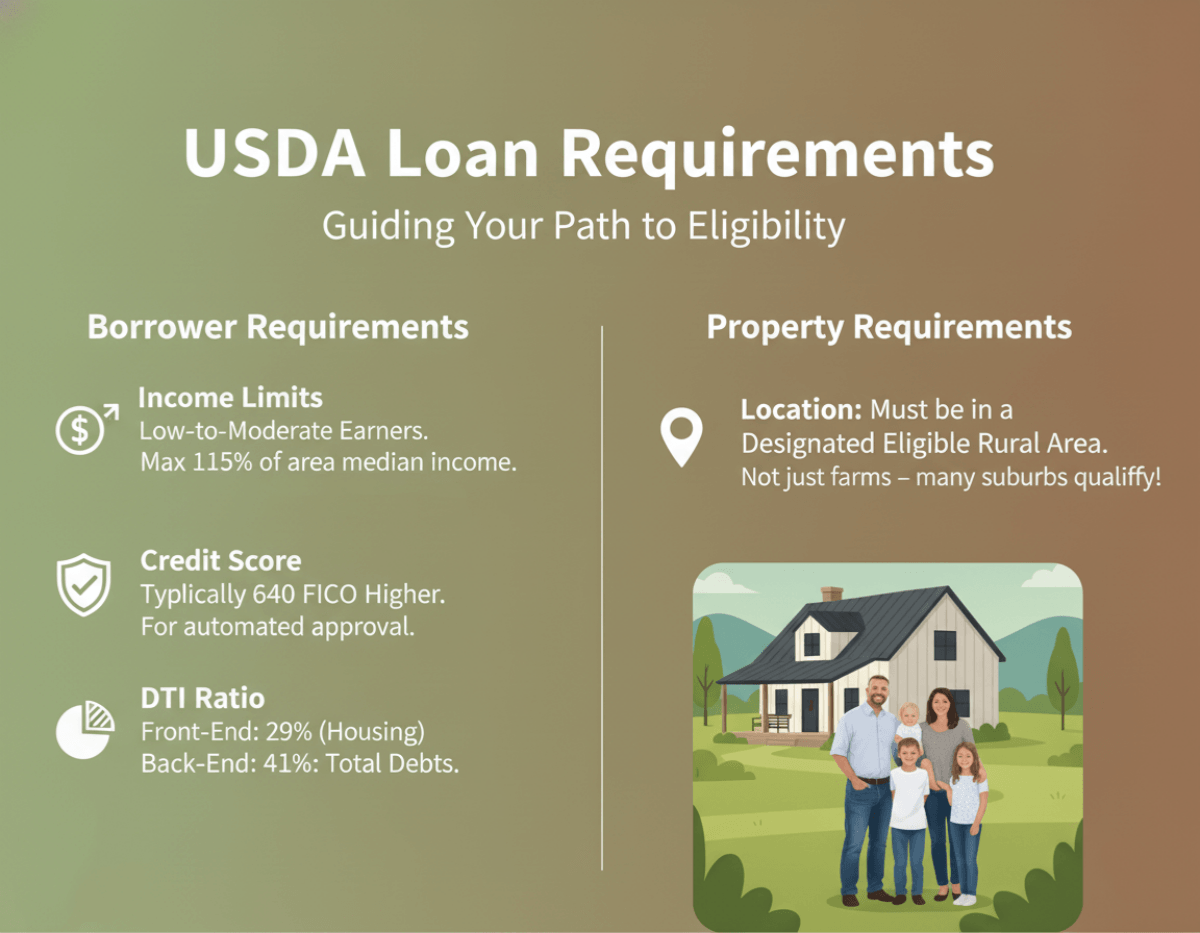
  • Income Limits: This program is strictly for low-to-moderate earners. Your total household income cannot exceed 115% of the area's median income. For 2026, standard limits generally sit at $119,850 for a family of 1-4, and $158,250 for 5-8 members. Keep in mind, this includes the income of everyone living in the house, even if they aren't on the actual mortgage application.
  • Credit Score: While the government doesn't set a hard minimum, most private lenders look for a 640 FICO score to run your file through automated approval systems.
  • DTI Ratio: USDA has no strict official DTI limits, but lenders typically prefer a front-end ratio of 29% (housing costs) and back-end ratio of 41% (total debts). Higher ratios may be approved with compensating factors. That means no more than 29% of your gross monthly income goes toward housing, and 41% toward total debts.
  • Location: The house must sit within a designated eligible rural or suburban zone.
USDA Loan Requirements

Pros and Cons of USDA Loans

Every mortgage product has trade-offs. To give you a realistic picture, here is an objective look at the advantages and disadvantages.

Pros

  • Zero Down Payment: Keep your cash in the bank for emergencies, moving costs, or new furniture.
  • Cheaper Mortgage Insurance: The 0.35% annual fee is usually much lower than standard FHA mortgage insurance or conventional PMI.
  • Competitive Rates: Enjoy lower interest rates thanks to federal backing.

Cons

  • Strict Income Caps: If you get a big promotion or raise, you might suddenly make too much money to qualify.
  • Geographic Restrictions: You absolutely cannot buy a house in major metropolitan centers.
  • Slower Closing Times: Because both the lender and the government have to sign off on the file, the underwriting process can occasionally take longer.

How to Get a USDA Loan?

Ready to move forward? The application process takes a little patience, but following these practical steps will keep you on track:

Step 1: Check your eligibility. Before falling in love with a house, confirm your income and target geography align with the rules. Again, plug your numbers into Zeitro Strata AI for a fast, accurate assessment.

Step 2: Find an approved lender. Not every bank offers these mortgages. Look for lenders who specialize in government-backed rural loans using Bluerate AI Agent so they can navigate the specific paperwork efficiently.

Step 3: Get pre-approved. Your lender will pull your credit, review your W-2s, and give you a pre-approval letter. This tells you your maximum purchase budget.

Step 4: Find a qualified property. Work with a real estate agent who understands the mapping restrictions to find a home that meets the safety and location standards.

Step 5: Apply and close. Once your offer is accepted, your lender finalizes the underwriting. After the federal office gives the final thumbs-up, you sign the papers and get the keys!

How to Get a USDA Loan?

USDA Loan VS FHA Loan

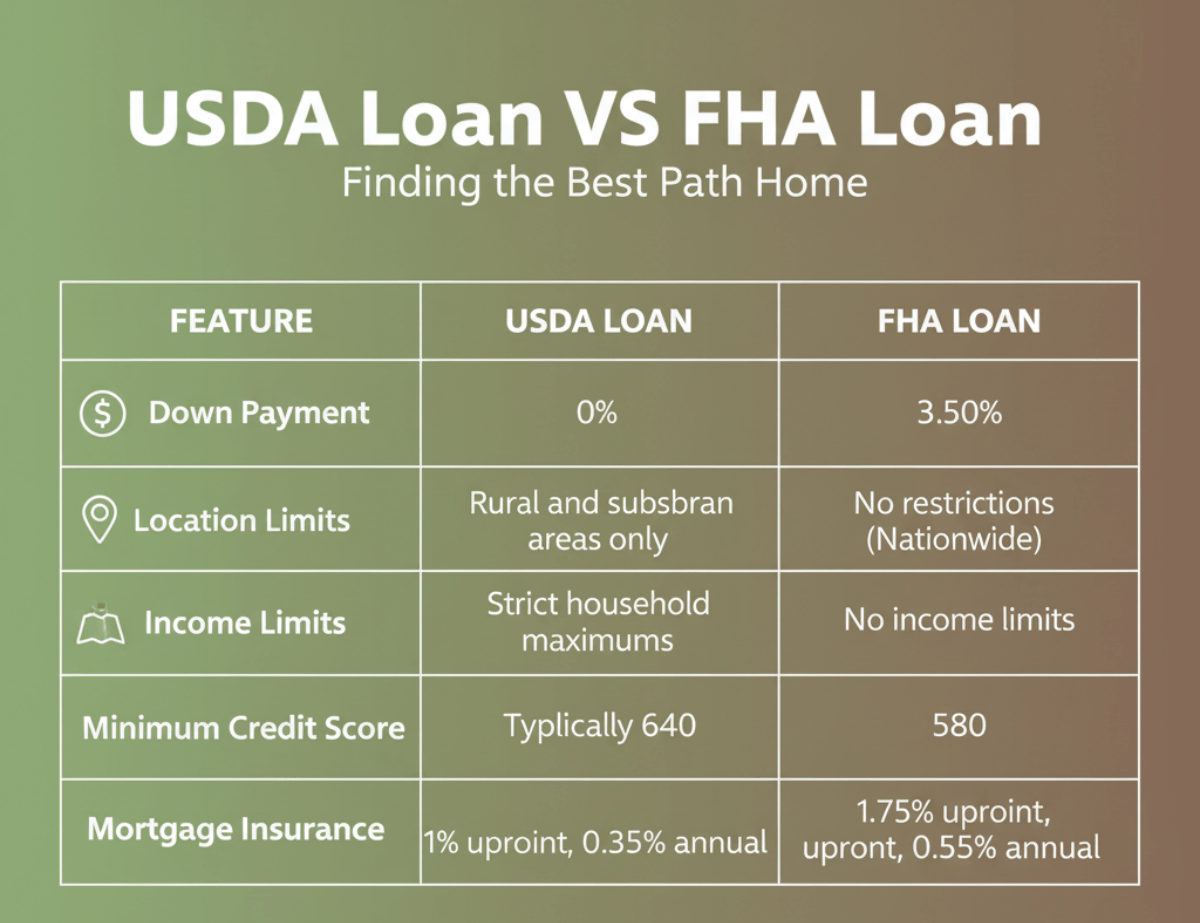
When trying to buy a house with minimal cash, most people weigh the USDA against the FHA program. The biggest difference is that FHA loans are available anywhere in the country but require a 3.5% down payment, whereas USDA loans offer zero down but limit where you can live and how much you can earn. I always tell buyers: if you want to live in a suburb and meet the income caps, the agricultural department's option is cheaper overall. If you want city life or have higher earnings, FHA is the way to go.

Here is a quick breakdown to help you compare:

USDA Loan VS FHA Loan

FAQs About USDA Loans

Q1. Are USDA loans hard to qualify for?

No, they aren't inherently difficult to secure. However, they do have strict geographic boundaries and firm household income caps. As long as you meet those two unique hurdles, the actual credit score and debt-to-income requirements are quite reasonable. A 640 score usually ensures smooth sailing.

Q2. Is USDA better than FHA?

There is no absolute winner. It depends entirely on your situation. If you are buying in an eligible suburban area and want to save cash, the USDA is better because of the zero down payment and cheaper fees. However, if you earn a high salary or prefer city living, FHA is the clear choice.

Q3. What is the maximum income for a USDA loan?

The maximum limit usually cannot exceed 115% of your specific local area's median income. For 2026, standard regions cap out at $119,850 for households of up to four people, and $158,250 for larger families. High-cost counties will feature significantly higher thresholds to match local living expenses.

Q4. What disqualifies you from a USDA loan?

Making too much money is the most common reason for denial. Other disqualifications include trying to buy a home within a major urban center, having a credit score severely below 580, or intending to use the property as an investment rental rather than your primary residence.

Q5. What is the 20% rule for USDA?

A common real estate myth says you need 20% down to avoid mortgage insurance. USDA completely ignores this rule by allowing 0% down. However, instead of private mortgage insurance (PMI), you are required to pay government guarantee fees (1% upfront and 0.35% annually) regardless of your down payment size.

Q6. Who is eligible for a USDA direct loan?

This specific tier is reserved strictly for low-to-very-low-income households who currently lack safe, sanitary housing and are completely unable to secure financing from traditional banks. The government funds these directly, often providing payment assistance subsidies that can temporarily drop the effective interest rate to 1%.

Q7. What is the USDA eligibility map?

It is an interactive online tool maintained by the agricultural department. It highlights which addresses sit in approved rural or suburban zones. Because borders shift during census updates, a house that qualified last year might not today, making this map crucial during your home search.

Conclusion

Buying a house doesn't have to drain your life savings. In my experience, the USDA loan remains one of the most powerful, underutilized tools for middle-class Americans looking to achieve homeownership without a down payment. While navigating the income caps and geographic boundaries might seem intimidating at first, the financial payoff of 100% financing and reduced mortgage insurance is absolutely worth the effort.

People Also Read

What is Mortgage Eligibility Checker? Best Tool to Verify Guidelines

Blog

5 min read
Arrow icon on dark background
What is Mortgage Eligibility Checker? Best Tool to Verify Guidelines
Looking for the best mortgage eligibility checker? Discover how AI tools help loan officers verify guidelines in seconds and save 7+ hours per loan.

As a mortgage professional, I know firsthand how exhausting the loan origination process can be. The constant battle of matching borrower profiles against hundreds of pages of complex investor rules is not just labor-intensive—it's a massive bottleneck. If you are searching for a way to quickly and accurately verify mortgage guidelines, you aren't alone.

We all need a reliable tool to stop wasting hours on manual underwriting. In this guide, I'll explain what a mortgage eligibility checker does and show you why leveraging an AI-powered assistant is the absolute best way to cut your research time down to literal seconds.

What is a Mortgage Eligibility Checker?

A mortgage eligibility checker is a specialized system that cross-references borrower data against vast investor guidelines to determine loan qualification. Historically, this meant flipping through massive PDFs or relying on clunky spreadsheets. Today, the most effective solution is a dedicated AI Agent.

After testing several platforms, my top recommendation for the US market is Zeitro. Founded in 2018 by engineering leaders from Google and Apple, it's an AI-native, completely neutral tech company with no lender affiliations. What gives me real peace of mind is their SOC 2 Type II certification, meaning your borrowers' sensitive data is protected by enterprise-grade security.

Their standout feature is Zeitro Strata AI, a wildly powerful guideline assistant. It uses a "DeepSearch" function to cross-check over 100 investors and 300+ guidelines simultaneously. Whether you are dealing with standard conventional loans or tricky Non-QM scenarios, like DSCR, ITIN, or Bank Statement loans, it delivers pinpoint accurate answers in seconds. Best of all, it provides exact source citations so you can confidently verify the information yourself. If a rule seems confusing, the "Explain" feature breaks it down further. You can even type your queries in multiple languages, including Chinese.

What is a Mortgage Eligibility Checker?

Beyond just guideline verification, Zeitro offers a complete ecosystem to streamline your entire workflow:

  • GrowthHub: Lets you launch a personalized microsite to boost your SEO, display live rates, and capture organic leads.
  • Digital 1003 (POS): Automates the borrower application, calculates DTI instantly with AI, and exports seamlessly in FNM 3.4 format.
  • Pricing Engine: A real-time rate quote tool for both conventional and Non-QM products to help you offer competitive pricing on the spot.

Who is a Mortgage Eligibility Checker for?

In today's highly competitive housing market, the professional who delivers accurate pre-qualifications the fastest usually wins the deal. A robust eligibility checker is practically mandatory for anyone involved in loan origination.

Loan Officers & Brokers: If you interact directly with borrowers, this tool is a total game-changer. By automating the heavy lifting, you can deliver pre-qualifications 2.5 times faster and save over 7 hours per loan file. This frees you up to focus on relationship-building and bringing in new business.

Wholesalers & Lenders: For teams managing high volumes or complex lending criteria, eliminating 100% of manual guideline research is crucial. Using an AI system ensures an 85%+ income calculation accuracy, allowing your team to close loans up to 20% faster and ultimately increase your total closed loans by 30%.

Who is a Mortgage Eligibility Checker for?

Also Read:

How to Use a Mortgage Eligibility Checker?

Ditching the old method of manually hitting "CTRL+F" through endless PDFs is incredibly liberating. To show you how simple it is, here is how I use Zeitro Strata AI to check mortgage eligibility in my own daily workflow:

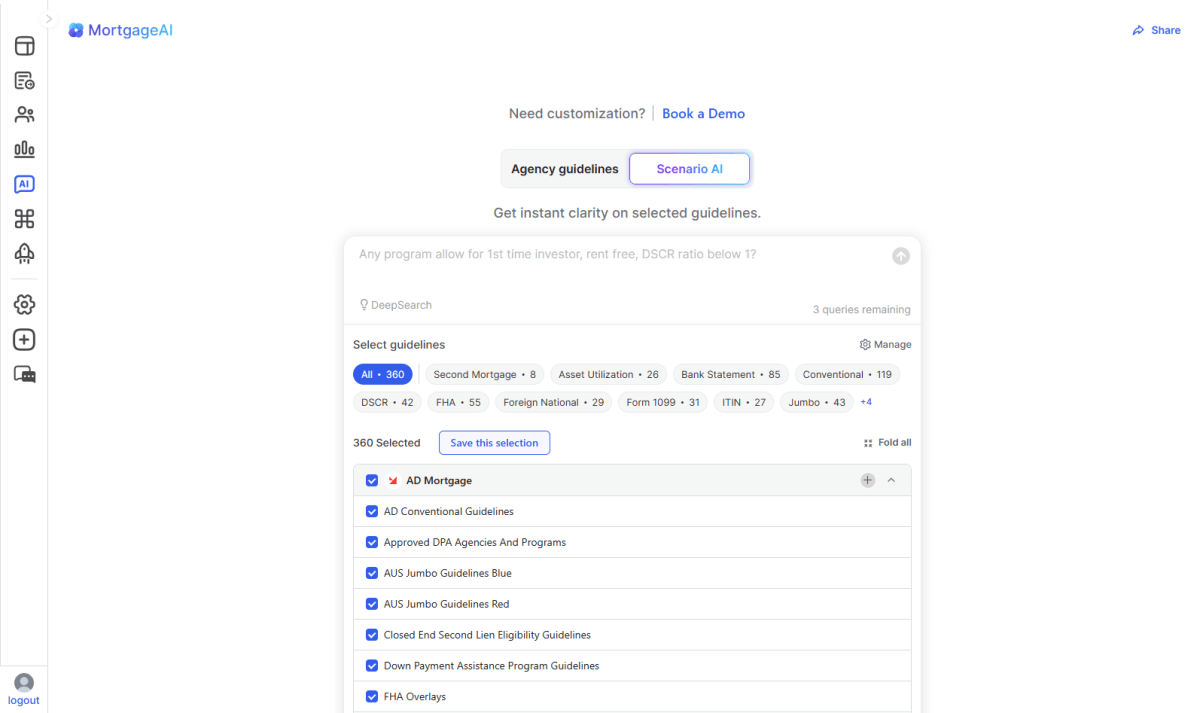
STEP 1. Input Your Scenario: Simply type your question into the chat interface. You can ask broad "what is" questions or highly specific eligibility queries. It even natively supports both English and Chinese inputs.

STEP 2. Customize Your Scope: Apply custom tags like DSCR, ITIN, loan-type, or specific investor names. This instantly narrows the DeepSearch to the exact programs you actually care about.

STEP 3. Get Instant, Sourced Answers: Within seconds, the AI provides a precise answer. I always click the provided citation link to double-check the source for 100% accuracy. If a specific caveat is unclear, I just use the "Explain" function for a deeper breakdown.

STEP 4. Share & Proceed: Once verified, you can easily share the results via a link or email to keep your clients and real estate partners perfectly in the loop.

How to Use a Mortgage Eligibility Checker?

FAQs About a Mortgage Eligibility Checker

Can an AI eligibility checker handle Non-QM loans?

Absolutely. In my experience, this is where a tool like Zeitro Strata AI truly shines. It continuously updates over 300 guidelines from major US lenders like AAA Lending, AD Mortgage, and AmWest, with deep support for complex Non-QM products like Profit and Loss, Foreign National, and DSCR loans.

How accurate are the AI-generated guideline answers?

They are highly accurate because the AI doesn't just guess or hallucinate. It actively cross-checks the most up-to-date guidelines and provides exact citations. You can always trace the answer back to the original source document, which virtually eliminates human error.

How much does a mortgage eligibility checker cost?

Pricing is surprisingly accessible. Zeitro offers a Freemium model. Their popular Explorer plan is completely free, giving you 3  queries per day, a personal website, and 10 lifetime FNM 1003 exports. For power users, it's just $8/month per user or $35/month per company.

Is my borrowers' data secure?

Yes. Security is a non-negotiable top priority in our industry. Zeitro is SOC 2 Type II certified. This means they maintain strict, enterprise-grade operational controls, ensuring all your sensitive customer data is fully protected from start to finish.

Final Word

Navigating the complexities of the US mortgage market shouldn't mean drowning in endless paperwork. A reliable mortgage eligibility checker is no longer just a luxury. It's an absolute necessity for modern loan professionals who want to scale their business. By adopting an AI Agent like Zeitro Strata AI, you can drastically improve your client satisfaction, speed up the lending process, and see a real boost in your overall ROI.

If you are tired of wasting hours on manual guideline research and want to close loans faster, it is time to make a change. I highly recommend taking advantage of Zeitro's Free Explorer Plan. You get three free queries every single day. So go ahead, test a complex scenario, and experience the magic of instant, accurate guideline verification for yourself.

How to Check Mortgage Eligibility? Quick and Accurate with Sources

Blog

5 min read
Arrow icon on dark background
How to Check Mortgage Eligibility? Quick and Accurate with Sources
Find out how to check mortgage eligibility quickly in 2026. Explore DTI, loan types, and how professionals verify complex guidelines accurately.

Whenever I talk to homebuyers or fellow loan professionals, one common frustration always comes up: mortgage guidelines are painfully complex and constantly changing. If you're wondering how to check mortgage eligibility in 2026, you're definitely not alone. Figuring out whether a borrower qualifies traditionally takes hours of digging through massive PDF manuals.

But the process is evolving. While everyday buyers still need to understand the basic requirements to do a quick self-check, mortgage professionals can now instantly verify mortgage eligibility with accurate sources using AI-native tools like Zeitro, which even offers free daily queries to get started.

What is Mortgage Eligibility?

Mortgage eligibility is simply the set of financial criteria lenders use to decide if you can afford to repay a home loan. When I evaluate a file, I look at factors like income history, debts, credit, and down payment. Since limits update annually, here are the baseline minimum requirements for 2026:

  • Conventional Loans: You'll need a minimum credit score of 620 and at least 3% down. The 2026 baseline conforming loan limit for most U.S. counties is $832,750 for a single-family home, with high-cost areas up to $1,249,125.
  • FHA Loans: Ideal for lower credit. You need a 580 score for a 3.5% down payment.
  • VA & USDA Loans: Both offer 0% down options for eligible veterans or rural buyers, though most lenders prefer a 620-640 credit score.
  • Non-QM Loans: These skip traditional W2 requirements. If you're self-employed, you can qualify using alternative methods like bank statements or DSCR (Debt Service Coverage Ratio) for investment properties.
What is Mortgage Eligibility?

Also Read:

Who Needs to Comply with Mortgage Eligibility?

You might think these rules only apply to the person buying the house, but compliance is actually a two-way street. Both sides of the transaction must strictly follow the guidelines to ensure a successful closing.

  • Borrowers: Whether you are a standard W-2 employee seeking a conventional mortgage or a real estate investor applying for a Non-QM loan, you must prove you meet the lender's financial thresholds to get approved.
  • Lenders and Loan Professionals: Brokers, loan officers, and wholesalers must meticulously verify every applicant against massive rulebooks. If we approve a loan that doesn't actually comply with the stated mortgage eligibility guidelines, the lender risks massive financial penalties or holding unsalable loans.

Why Do You Need to Check Mortgage Eligibility?

I always advise my clients and colleagues to run the numbers before even opening Zillow. Why? Because checking your status upfront saves a lot of heartbreak and wasted time.

  • Understand Purchasing Power: You immediately know your realistic price range, preventing you from falling in love with a home you simply can't finance.
  • Identify Red Flags Early: A quick check reveals credit reporting errors or high debts, giving you time to fix them before officially applying.
  • Speed Up Pre-qualification: Having your numbers ready makes the formal pre-qualification process much faster, letting you make aggressive offers in a competitive market
  • Find the Right Loan Program: It helps match you to the perfect product. If your tax returns don't show enough income, checking early reveals that you should pivot to a Non-QM bank statement loan instead.
Why Do You Need to Check Mortgage Eligibility?

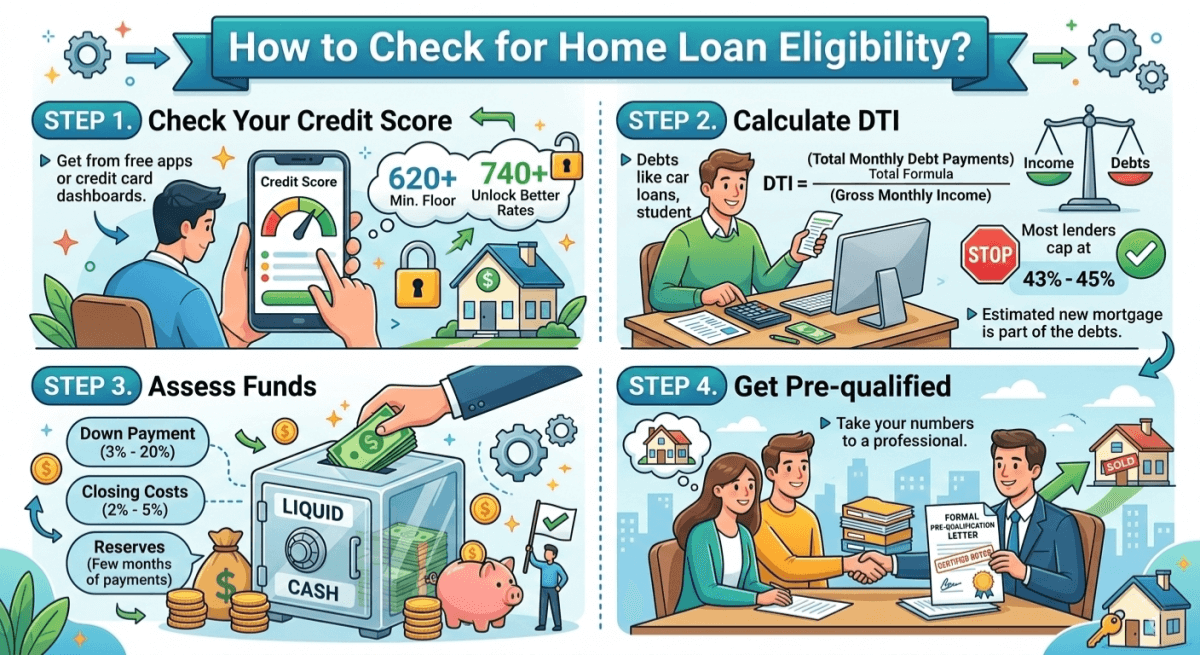
How to Check for Home Loan Eligibility?

If you want to know where you stand, doing a basic self-assessment is easier than you think. Here are the steps I recommend to check for home loan eligibility before contacting a bank.

STEP 1. Check Your Credit Score

Your credit dictates almost everything. Pull your score from a free app or your credit card dashboard. Keep in mind that a 620 is the floor for conventional options, but pushing that score above 740 will unlock significantly better interest rates and cheaper mortgage insurance.

STEP 2. Calculate DTI

Lenders care deeply about your Debt-to-Income (DTI) ratio. Take your total monthly debt payments (car loans, minimum credit card payments, student loans) plus your estimated new mortgage payment, and divide that by your gross monthly income. Most QM (Qualified Mortgage) lenders cap this at 43% to 45%.

STEP 3. Assess Funds

Look at your liquid cash. You need enough to cover the down payment (anywhere from 3% to 20%), plus closing costs (usually 2% to 5% of the loan amount). Lenders also like to see "reserves," which is a few months of mortgage payments sitting safely in your bank account.

STEP 4. Get Pre-qualified

Once you've run your own numbers, take them to a professional. A loan officer can run a soft credit pull and give you a formal pre-qualification letter, which proves to sellers that you are a serious and capable buyer.

How to Check for Home Loan Eligibility?

How to Verify Mortgage Eligibility? (For Professionals)

While borrowers can do a rough self-check, loan officers and brokers face a much harder task. We have to cross-reference borrower data against 300+ constantly shifting guidelines to verify eligibility. It used to be a nightmare of manual reading, but now, I rely on Zeitro Strata AI.

Zeitro is an AI-native SaaS platform built exclusively for the U.S. mortgage industry. This mortgage AI is an incredibly powerful mortgage guideline assistant that completely transforms how we work. Here is what it brings to the table:

  • Instant DeepSearch with Citations: Instead of spending 30 minutes reading PDFs, you can type a scenario and get an accurate answer in seconds. It cross-checks over 100 investors and provides exact citations, so you always have a verifiable source.
  • Comprehensive Non-QM & QM Coverage: It doesn't just know Fannie Mae and FHA. Zeitro Strata AI covers complex Non-QM scenarios, like Asset Utilization, DSCR, ITIN, and Foreign National loans, from mainstream lenders like AD Mortgage and Luxury.
  • Customizable Scenario Analysis: You can narrow searches using custom tags for specific loan types or lenders. If an answer seems complicated, the "Explain" feature acts as a secondary AI review to break down the logic further.
  • Boost Efficiency & Close Rates: Using Zeitro saves professionals over 7 hours per loan file and delivers 2.5x faster pre-qualifications. Plus, it currently offers 3 free queries a day, making it easy to test out.
How to Verify Mortgage Eligibility? (For Professionals)

FAQs About Checking Mortgage Eligibility

Does checking my mortgage eligibility hurt my credit score?

Usually, no. An initial pre-qualification check by a lender only requires a "soft pull," which has zero impact on your credit score. It's only when you move forward with a formal, full application that a "hard pull" occurs.

Can I get a mortgage with a high DTI ratio?

Yes, it's definitely possible. If your DTI exceeds the traditional 45% limit, you might need to make a larger down payment, pay off smaller debts, or explore Non-QM loans that offer much more flexible debt-to-income underwriting standards.

What is the difference between Pre-qualification and Pre-approval?

Pre-qualification is a quick estimate of how much you can borrow based on unverified information you provide. Pre-approval carries much more weight because the lender has thoroughly verified your tax returns, bank statements, and actual credit report.

How do Non-QM loans affect eligibility?

Non-QM (Non-Qualified Mortgage) loans drastically expand eligibility for people who don't fit the standard mold. Instead of requiring traditional W-2s, they allow self-employed buyers or investors to qualify using alternative documents like bank statements or property rental income.

How long does a mortgage eligibility check take?

For a buyer doing a basic self-assessment, it takes just a few minutes. For mortgage professionals using modern AI tools like Zeitro, verifying complex, multi-layered investor guidelines now literally takes seconds instead of hours.

Conclusion

Understanding your borrowing power is the crucial first step in any real estate journey. Whether you're aiming for a standard conventional loan or a complex DSCR setup, knowing your 2026 limits and requirements saves everyone involved massive amounts of time.

  • If you are a mortgage professional tired of manually digging through guidelines, you need to modernize your workflow. I highly recommend trying Zeitro Strata AI. It gives you fast, fully-cited answers and you can start with 3 free queries every day to instantly boost your productivity.
  • On the other hand, if you are a homebuyer ready to find out exactly what you qualify for, head over to Bluerate. There, you can connect directly with top-tier loan officers equipped with the best technology to get a free consultation and personalized rate quotes today.

People Also Read

Try Zeitro today and transform your loan origination workflow!

Get started free